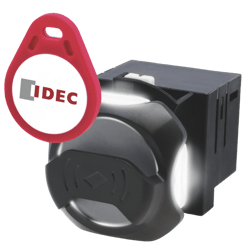
All about the KW2D smart RFID reader
Everything you need to know about implementing RFID-based access control and traceability at the machine level.
KW2D is designed to simplify machine access control, improve traceability, and integrate seamlessly into industrial control systems.
Below, you’ll find answers to the most common questions about RFID technology, PLC communication, installation, environmental constraints, and typical industrial use cases.
General information
What is the KW2D Smart RFID Reader?
KW2D is an industrial RFID reader designed to manage machine access control and traceability at the control level. It integrates directly into PLC or HMI based systems and enables user identification, role-based access, and event tracking using RFID tags.
What is KW2D typically used for?
KW2D is commonly used to:
- Control access to machine functions and settings
- Identify operators, maintenance staff, or supervisors
- Improve traceability of machine access and interactions
- Reduce errors during setup, changeover, or maintenance
Can KW2D be used in retrofit applications?
Yes. KW2D is designed for easy integration into both new and existing machines. Its 22 mm panel-mount format and standard industrial communication protocols make it suitable for retrofit projects.
Can the KW2D read & write to and from tags?
No. The KW2D is a read only device for added security.
RFID technology & tags
What operating frequency does the KW2D RFID reader use?
The KW2D operates at 13.56 MHz High Frequency (HF) and supports Type A, Type F, and Type V RFID standards, which are commonly used in industrial RFID applications.
What type of RFID tags does IDEC use?
IDEC uses passive RFID tags, which do not require batteries. These tags are lightweight, durable, and well suited for industrial environments.
What styles of RFID tags does IDEC offer?
IDEC offers card-style and key fob RFID tags, designed for daily industrial use. The tags are color-coded to simplify user role identification and access level management.
How does the RFID system work?
Each RFID tag contains a unique identifier. When a user presents a tag, the KW2D reader transmits this ID to the control system, where it can be associated with specific users, roles, or authorization levels within the PLC logic.
Is it mandatory to use IDEC RFID tags?
No. While IDEC RFID tags offer enhanced security features, KW2D also supports third-party RFID tags operating at 13.56 MHz (Type A, F, or V). Compatibility depends on the tag standard used.
Security & access control
What security features are included in the IDEC RFID solution?
The KW2D solution supports encrypted communication between the RFID tag and the reader. IDEC tags include additional security mechanisms compared to standard RFID tags, reducing the risk of unauthorized access.
Is it possible to duplicate an IDEC RFID tag?
IDEC RFID tags include an additional encryption code as an authenticity verification bit. This allows the system to detect whether a tag is a genuine IDEC tag, significantly reducing duplication risks.
Can new RFID tags be issued without reprogramming the system?
Yes. New RFID tags can be issued without reprogramming the software or using a computer, by leveraging predefined authorization levels. IDEC’s color-coded tags are preset to simplify deployment and day-to-day management.
Electrical & environmental specifications
How is the RFID reader mounted?
KW2D is designed for installation in a standard 22 mm panel cutout, allowing it to be mounted alongside conventional industrial control devices such as pushbuttons, selector switches, and indicator lights.
Is KW2D suitable for industrial environments?
Yes. KW2D is rated IP65/IP67, offering protection against dust, water, and oil. It is also designed to operate reliably on metal panels commonly found in industrial automation environments.
Can new RFID tags be issued without reprogramming the system?
Yes. New RFID tags can be issued without reprogramming the software or using a computer, by leveraging predefined authorization levels. IDEC’s color-coded tags are preset to simplify deployment and day-to-day management.
PLC integration & communication
Which communication protocols are supported?
KW2D supports standard industrial Ethernet protocols, including:
- Modbus TCP (Server)
- EtherNet/IP (Adapter)
- CC-Link IE Field Basic (Slave)
Can KW2D interface with PLCs and HMIs from other manufacturers?
Yes. KW2D can be integrated into control systems from major PLC manufacturers. Typical integrations include platforms from Beckhoff, IDEC, Mitsubishi, Omron, Rockwell Automation, Siemens, and Schneider Electric.
Does KW2D require middleware or a gateway?
No. KW2D communicates directly with the PLC using standard industrial protocols. No middleware, additional gateways, or proprietary controllers are required.
Typical usage & system logic
How are access levels managed?
Access levels can be assigned to each user utilizing the KW2D configuration software or can be handled through the PLC or control logic. Different RFID tags can be assigned to different authorization levels, allowing operators, maintenance personnel, and supervisors to access only the functions relevant to their role.
Can KW2D support traceability?
Yes. Each RFID interaction can be logged by the control system, enabling traceability of who accessed the machine and when. This supports troubleshooting, accountability, and process optimization.